
The American Board of Infection Control: The Gold Standard in Infection Prevention
(CBIC)
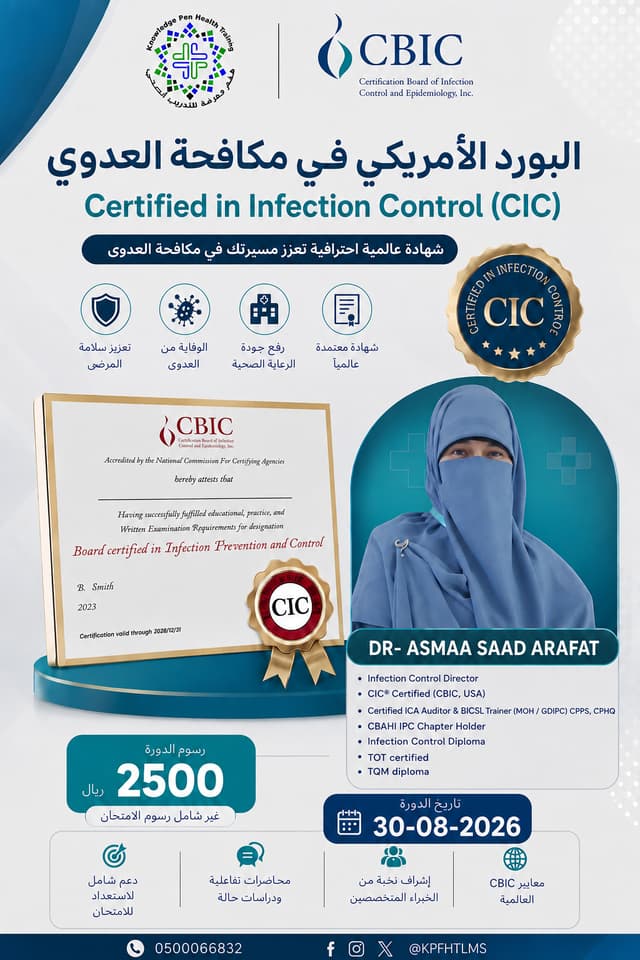
"Knowledge Pen Health Training Center" center is pleased to announce the American Board Course in Infection Control and Epidemiology (CBIC), under the supervision of Dr. Mai Al-Ghamrawi.
The course offers specialized scientific content and real-world applications through a weekly lecture held every Monday from 8:00 PM to 10:00 PM, spanning 5 months starting from June 26, 2026.
Registration Fee: 2,500 SAR (Please note that this fee does not include the international exam fees).
Learning Outcomes of the American Board of Infection Control (CBIC)
The American Board of Infection Control (CIC) certification represents a global standard of excellence in the field of infection prevention. The content of this certification covers an integrated set of knowledge and skills that specialists must master. The main learning outcomes can be classified into the following areas:
First: The Field of Infectious Disease Processes
This area focuses on the scientific basis of infectious diseases, enabling the specialist to:
- Accurately distinguish between bacterial colonization, active infection, and microbial contamination
- Apply proper practices for collecting and transporting diagnostic specimens for laboratory analysis
- Interpret laboratory reports and correlate them with the patient's clinical signs
- Understand the mechanisms of action of antibiotics and participate in antimicrobial stewardship programs
Second: The Field of Surveillance and Epidemiologic Investigation
The specialist acquires advanced skills in tracking and analyzing infections, including:
- Designing effective systems for infection surveillance within healthcare facilities
- Collecting and analyzing epidemiologic data using appropriate statistical measures
- Calculating indicators such as infection prevalence rate, incidence rate, and attack rate
- Applying scientific investigation steps during outbreaks to identify sources and implement control measures
Third: The Field of Preventing and Controlling Infection Transmission
The specialist becomes able to apply preventive practices in the clinical environment, such as:
- Implementing standard precautions and transmission-based isolation precautions
- Ensuring the correct use of personal protective equipment and its safe disposal
- Applying principles of safe injection practices and handling of medical solutions
- Overseeing hand hygiene programs and infection control strategies related to patient care
Fourth: The Field of Employee and Occupational Health
This focuses on protecting healthcare personnel from occupational risks, and includes:
- Assessing risks of occupational exposure to infectious diseases in the work environment
- Managing exposure incidents to infectious microorganisms in coordination with employee health services
- Overseeing periodic health screening and vaccination programs for healthcare workers
Fifth: The Field of Management and Communication
The specialist develops leadership competencies enabling them to:
- Plan infection control programs and prioritize them according to the facility's needs
- Apply quality improvement and patient safety methodologies, such as problem-solving models
- Communicate effectively with medical and administrative teams and provide feedback based on data
- Write professional reports and participate in specialized committees
Sixth: The Field of Education and Research
The specialist gains the ability to transfer knowledge and contribute to scientific development by:
- Designing effective educational programs for healthcare workers and patients
- Evaluating scientific research and studies and applying evidence-based findings to improve clinical practices
- Using various strategies to transfer knowledge and change incorrect behaviors
Seventh: The Field of the Environment of Care
The specialist becomes capable of assessing environmental risks surrounding the patient, including:
- Overseeing environmental cleaning practices and disinfection techniques
- Assessing infection risks associated with healthcare facility design, construction, and renovation
- Monitoring essential elements of the care environment such as ventilation systems and water quality
Eighth: The Field of Cleaning, Disinfection, and Sterilization
The specialist possesses in-depth knowledge of medical device reprocessing processes, including:
- Identifying appropriate practices for cleaning, disinfecting, and sterilizing devices and equipment
- Overseeing critical steps in high-level disinfection and sterilization processes
- Assessing the reprocessing feasibility of new or complex medical products
Conclusion
These eight areas represent the integrated framework of knowledge and skills ensured by the American Board of Infection Control. This framework combines scientific, practical, and leadership aspects, qualifying the certification holder to be a recognized expert capable of leading infection prevention programs and enhancing patient safety across various healthcare institutions
This session is only available for enrolled students. Please register or log in to get your unique Zoom link.
🩺 Medicine
🏘️ Health Management and Community Health
♿ Therapy and Rehabilitation
💊 Pharmacists and Pharmacy Technicians
🧪 Medical Laboratories and Technology
🦷 Dentistry
👩⚕️ Nursing and Midwifery
🩻 Health Technicians and Assistants
🎓 Students and Internship Trainees
⚕️ All Health Specialties

Price includes VAT
 Start AtEnd At
 Duration
 Available Certificate