
Introduction to the American Board of Medical Laboratory Science (MLS)
The American Board of Medical Laboratory Science (MLS), officially known as the American Certification in Medical Laboratory Science, is a professional credential granted by prominent American accrediting bodies such as the American Society for Clinical Pathology (ASCP) and other internationally recognized institutions.
This certification is regarded as one of the most prestigious professional qualifications in the field of medical laboratory science worldwide, serving several key objectives:
First, it demonstrates the holder's competence and advanced level of theoretical knowledge and practical skills across all core laboratory disciplines, including hematology, microbiology, clinical chemistry, blood banking, and immunology. Second, it ensures that laboratory practices align with the latest protocols and global standards adopted in the United States. Third, it expands career opportunities for certified professionals, enhancing their chances of working in prestigious hospitals and distinguished research centers.
This certification is awarded to specialists holding a bachelor's or master's degree in medical laboratory sciences, following successful completion of a comprehensive examination covering all aspects of laboratory work, in addition to meeting the required practical experience criteria.
Earning the American Board (MLS) certification represents a significant milestone in the career of medical laboratory professionals, reflecting their commitment to professional excellence and delivering the highest quality of diagnostic care
Learning Outcomes of the American Board of Medical Laboratory Science (MLS)
Earning the American Board of Medical Laboratory Science (MLS) certification represents the culmination of an advanced stage of education and training, confirming that the holder possesses an integrated set of knowledge, skills, and competencies. The learning outcomes of this certification can be classified into the following main areas:
First: Cognitive Competence in Core Laboratory Specialties
The holder of the American Board certification is proficient in performing, analyzing, and interpreting results across all major sections of the medical laboratory, which include:
Blood Bank: Understanding the principles of immunohematology, performing compatibility tests, managing blood products and components, and handling rare antibody reactions.
Clinical Chemistry: Mastering the performance and analysis of various biochemical tests, understanding metabolic disorders, operating automated chemistry analyzers, and calibrating their performance.
Hematology: Distinguishing between different blood cells in normal and pathological conditions, performing coagulation tests, and interpreting results related to benign and malignant blood disorders.
Microbiology: Isolating and diagnosing pathogenic microorganisms, performing antibiotic susceptibility tests, and understanding mechanisms of drug resistance.
Immunology: Performing and interpreting various immunological tests, and understanding the fundamentals of immune responses in infectious diseases and autoimmune disorders.
Urinalysis and Body Fluids: Performing physical, chemical, and microscopic analysis of urine and other body fluids, and correlating results with various clinical conditions.
Second: Operational Competence and Quality Management in the Laboratory
The laboratory specialist holding the board certification possesses the ability to manage daily laboratory operations with high efficiency, while adhering to stringent quality and safety standards. These competencies include:
Quality Control and Assurance: Applying principles of internal and external quality control, analyzing test quality data, and taking corrective actions when necessary to ensure accurate results.
Professional Safety: Committing to the application of biological, chemical, and physical safety procedures in the laboratory, safely handling specimens and medical waste, and implementing infection control standards.
Problem-Solving and Troubleshooting: Employing critical thinking skills to identify and resolve issues related to specimens, tests, and equipment, ensuring efficient workflow.
Laboratory Mathematics: Mastering essential laboratory calculations such as dilutions, calibration, calculating solution concentrations, and analyzing basic statistical data.
Third: Professional Competence, Ethics, and Communication Skills
Learning outcomes are not limited to technical aspects but extend to include personal and professional skills that qualify the specialist to be an active member of the treating medical team:
Clinical Decision-Making: Evaluating laboratory data and correlating it with the patient's clinical condition, and contributing with the medical team to determine appropriate diagnostic and treatment pathways.
Ethical and Professional Conduct: Adhering to the highest standards of integrity, honesty, and confidentiality in handling patient information and results, and assuming full professional responsibility for the accuracy of the work provided.
Effective Communication: The ability to convey complex information and results to physicians and nursing teams in clear and understandable language, and collaborating effectively within the healthcare team.
This session is only available for enrolled students. Please register or log in to get your unique Zoom link.
🧪 Medical Laboratories and Technology

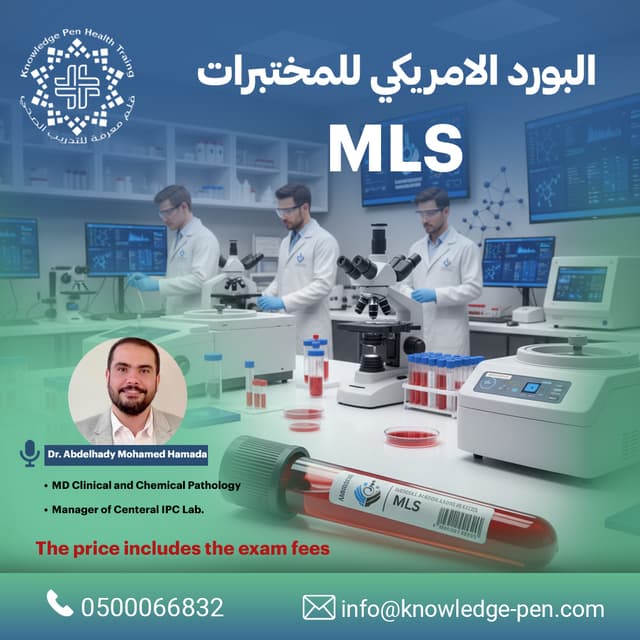
MD Clinical and Chemical Pathology Manager of Centeral IPC Lab. Ain Shams University Hospital Manager of Serology Unit. Reference Laboratory for Egyptian University Hospital
 Start AtEnd At
 Duration
 Available Certificate