
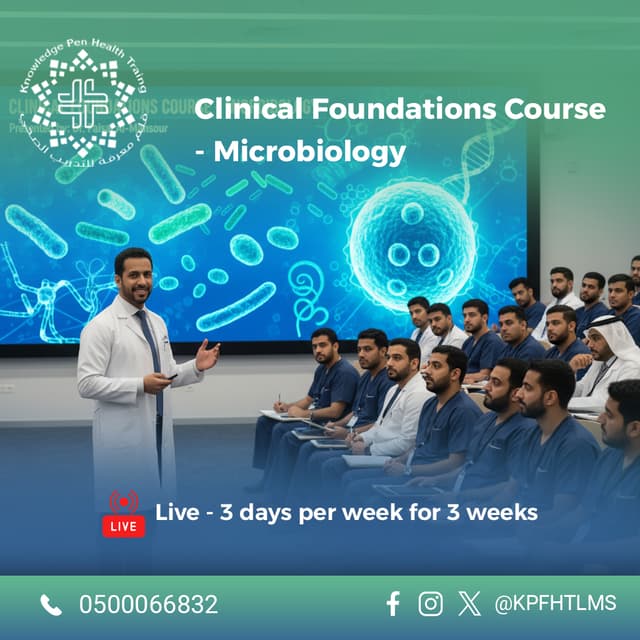
Introduction to the Clinical Foundations Course: Microbiology
Welcome to the Clinical Foundations Course in Microbiology. This course is designed to serve as a critical bridge between the basic scientific principles of microbiology and their direct application in a clinical setting. As future healthcare professionals, your ability to diagnose, treat, and prevent infectious diseases will depend on a solid understanding of the microscopic world and its complex interaction with the human body.
This course will move beyond simply identifying bacteria, viruses, fungi, and parasites. Our primary focus will be on the **pathogenesis** of infectious diseases—the biological mechanisms by which these microorganisms cause illness—and the **host response**. We will explore how specific pathogens evade the immune system, the epidemiology of common and emerging infectious diseases, and the rationale behind selecting appropriate antimicrobial therapies.
Throughout this course, we will emphasize a case-based approach, challenging you to apply your knowledge to real-world patient scenarios. Key topics will include:
- The fundamentals of microbial structure, genetics, and classification.
- The body's defense mechanisms and how they counteract microbial invasion.
- The major pathogens responsible for human disease, organized by body system.
- The principles of sterilization, disinfection, and infection control in healthcare environments.
- The mechanisms of antibiotic action, resistance, and the importance of antimicrobial stewardship.
- Laboratory techniques used to identify pathogens and interpret culture results.
By the end of this course, you will not only have a strong command of microbiological concepts but also the clinical reasoning skills to apply this knowledge at the bedside. We will work together to build a framework for understanding infectious disease that will be an essential part of your clinical toolkit
Learning Outcomes: Clinical Foundations Course - Microbiology
1. Classify and Differentiate Microorganisms
- Distinguish between the major groups of microorganisms (bacteria, viruses, fungi, and parasites) based on their structural characteristics, genetics, and replication strategies.
- Identify key pathogens responsible for human disease using fundamental laboratory identification techniques (e.g., Gram stain, culture characteristics, and biochemical tests).
2. Explain the Mechanisms of Microbial Pathogenesis
- Describe the specific virulence factors (e.g., toxins, adhesion factors, capsules) that enable microorganisms to colonize host tissues, evade the immune system, and cause cellular damage.
- Correlate these pathogenic mechanisms with the clinical signs and symptoms observed in specific infectious diseases.
3. Integrate Immunology with Infectious Disease
- Explain the role of the innate and adaptive immune systems in defending against bacterial, viral, and fungal infections.
- Analyze how specific pathogens employ immune evasion strategies to establish persistent or latent infections.
4. Interpret Laboratory Data and Diagnostic Tests
- Analyze and interpret laboratory reports, including Gram stain results, culture growth, and serological markers, to aid in the diagnosis of infections.
- Critically evaluate an antibiogram to determine the susceptibility or resistance patterns of a bacterial isolate and predict the clinical efficacy of various antibiotics.
5. Apply Principles of Antimicrobial Therapy and Resistance
- Explain the mechanisms of action of major classes of antimicrobials (antibacterial, antiviral, antifungal).
- Compare and contrast the biochemical mechanisms of antimicrobial resistance (e.g., enzymatic degradation, efflux pumps, target modification).
- Recommend appropriate empiric antimicrobial therapy based on the most likely pathogen, while considering the principles of antimicrobial stewardship.
6. Apply Infection Prevention and Control Strategies
- Justify the use of standard and transmission-based precautions in healthcare settings to prevent the spread of healthcare-associated infections.
- Discuss the role of public health measures, including vaccination and hygiene practices, in controlling the spread of communicable diseases in the community.
7. Synthesize Information in Clinical Case Scenarios
- Evaluate complex clinical case studies to formulate a differential diagnosis for a suspected infectious disease.
- Propose a logical diagnostic workup and a evidence-based management plan, integrating knowledge of microbiology, pharmacology, and host defense mechanisms
This session is only available for enrolled students. Please register or log in to get your unique Zoom link.
🩺 Medicine
🏘️ Health Management and Community Health
♿ Therapy and Rehabilitation
💊 Pharmacists and Pharmacy Technicians
🧪 Medical Laboratories and Technology
🦷 Dentistry
👩⚕️ Nursing and Midwifery
🩻 Health Technicians and Assistants
🎓 Students and Internship Trainees
⚕️ All Health Specialties

Price includes VAT
 Start AtEnd At
 Duration
 Available Certificate